
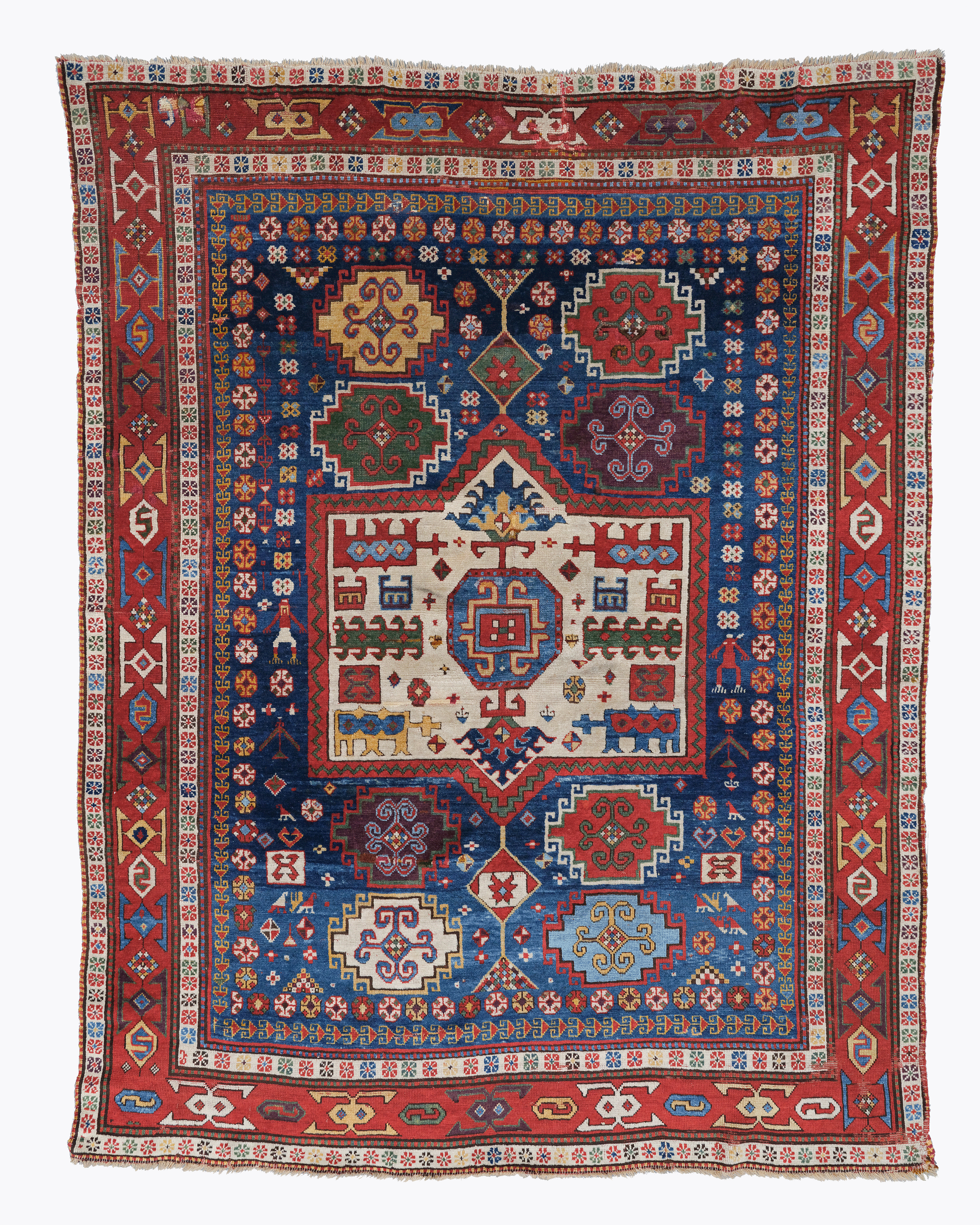


Antique Caucasian Rug
Period: Mid 19th Century
Origin: Caucasus
Dimensions: 176 x 224 cm
This wonderful rug is a formerly unpublished addition to a small and rare group of blue-ground Caucasian rugs whose design is dominated by a prominent decahedral gabled ivory medallion. The overall pattern echoes that of a group of earlier 17th and 18th century north west Persian carpets, whose designs were based upon the Persian garden plan known as the “Four Gardens” or Chahar Bagh (M.S.Dimand & J. Mailey, Oriental Rugs in the Metropolitan Museum of Art, New York, 1973, p.84, fig.116). The smaller lozenges that extend above and below the central medallion on the present lot, are linked by a narrow vertical channel which represents the streams and ornamental pools that feed the flowering trees and shrubs on either side. The once eight-pointed medallion, that is an archaic form found in early Anatolian and Caucasian rugs, and which continues to be used throughout the nineteenth century in Fachralo rugs, here has been simplified to just six points. Further more, the formerly square compartments filled with trees, are replaced here with “Memling” guls, most commonly associated with the weavings from the Moghan district in the Caucasus.
Eight other examples have been published, one in the Rudnick Collection, which is dated and most likely reads 1833 (J. Bailey and M. Hopkins, Through the Collector’s Eye – Oriental Carpets from New England Private Collections, Providence Rhode Island 1991, p.66, no.20); one by E. Gans-Ruedin, Caucasian Carpets, New York, 1986, pl.118, two by Eberhart Herrmann; the first dated to either 1844 or 1850 (E. Herrmann, Seltene Orienteppiche IV, Munich, 1982, p.152, no.46 and Herrmann, Kaukasische Teppichkunst Im 19. Jahrhundert Ein Bilderbuch, Munich 1993, p.61, pl.45); one of slightly shortened proportions by Ian Bennett, (Bennett, Oriental Rugs, Volume I Caucasian, London, 1981, p.79, no.66), two examples that sold at auction in the same week; Sotheby’s London, 28 April 1993, lot 16 and Christie’s London, 29 April 1993, lot 357, and the most recent to appear on the market which sold in these Rooms, 26 October 2017, lot 313. The Gans-Ruedin and Bennett examples, display two columns of double ‘Memling’ guls above and below the central medallion while the others all have three.
Apart from the Rudnick example which has a ‘Shield’ border, all of the other rugs share the same border pattern that consists of a series of small hexagons enclosing a large ‘S’ motif, with every other hexagon set within paired double-ended zoomorphs. The origin of this design stems from earlier Caucasian ‘Dragon’ carpets, and is almost identical to that of an eighteenth century east Caucasian rug, formerly in the collection of the late Peter Lehmann-Bärenklau, which sold in these Rooms, 19 April 2016, lot 20. The border is most frequently flanked by white ground guard stripes which display small flowerheads with a further inner frame of small space-invader motifs. Unique to the group, the present lot has an arrangement of small alternating yellow and ivory flower heads forming an additional frame within the central field which also sees the inclusion of two human figures flanking the central medallion.
An interesting rug in the Vakiflar Museum combines elements of this field with a debased version of the border but replaces the Memling guls with minor Karatchopf octagons (Serare Yetkin, Early Caucasian Carpets in Turkey, London 1978, Vol.1, pl.98). When discussing this rug, Tschebull (op.cit. pl.40) questions the short pile, loosely packed wefts and unusual end braids, as not being typical characteristics of Kazak rugs but as HALI suggests, despite having strong Moghan and Gendje attributes, further research is required, (“Auction Price Guide”, HALI, June/July 1993, Issue 69, p.147). Of this rare group, the present rug is one of the best preserved.
Stock No : 1499
Related products
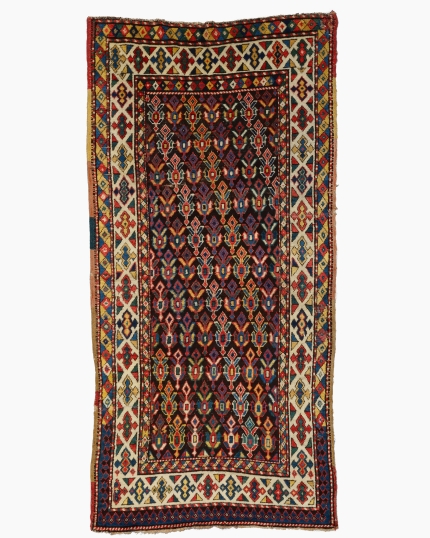
Antique Kazak Rug
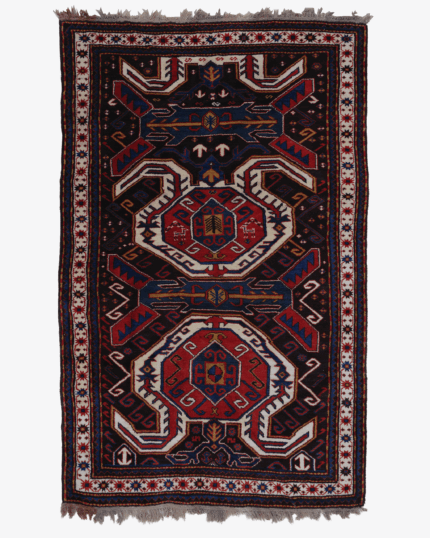
Antique Lenkoren Rug
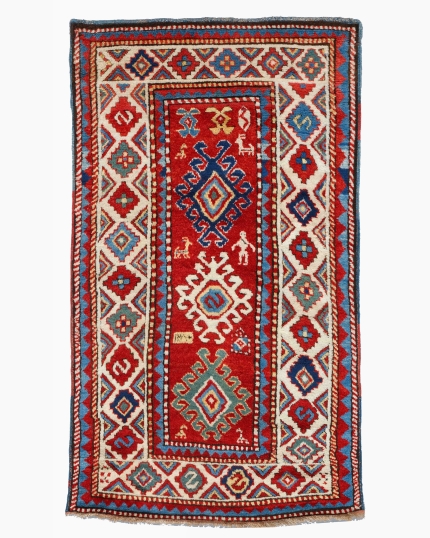
Antique Bordjalo Rug

Antique Shirvan Prayer Rug
Antique Perepedil Rug
Antique Chi-Chi Rug
Caucasian Sahnezar Rug



 Mimar Mehmetağa Cad. No:10 Sultanahmet / ISTANBUL