
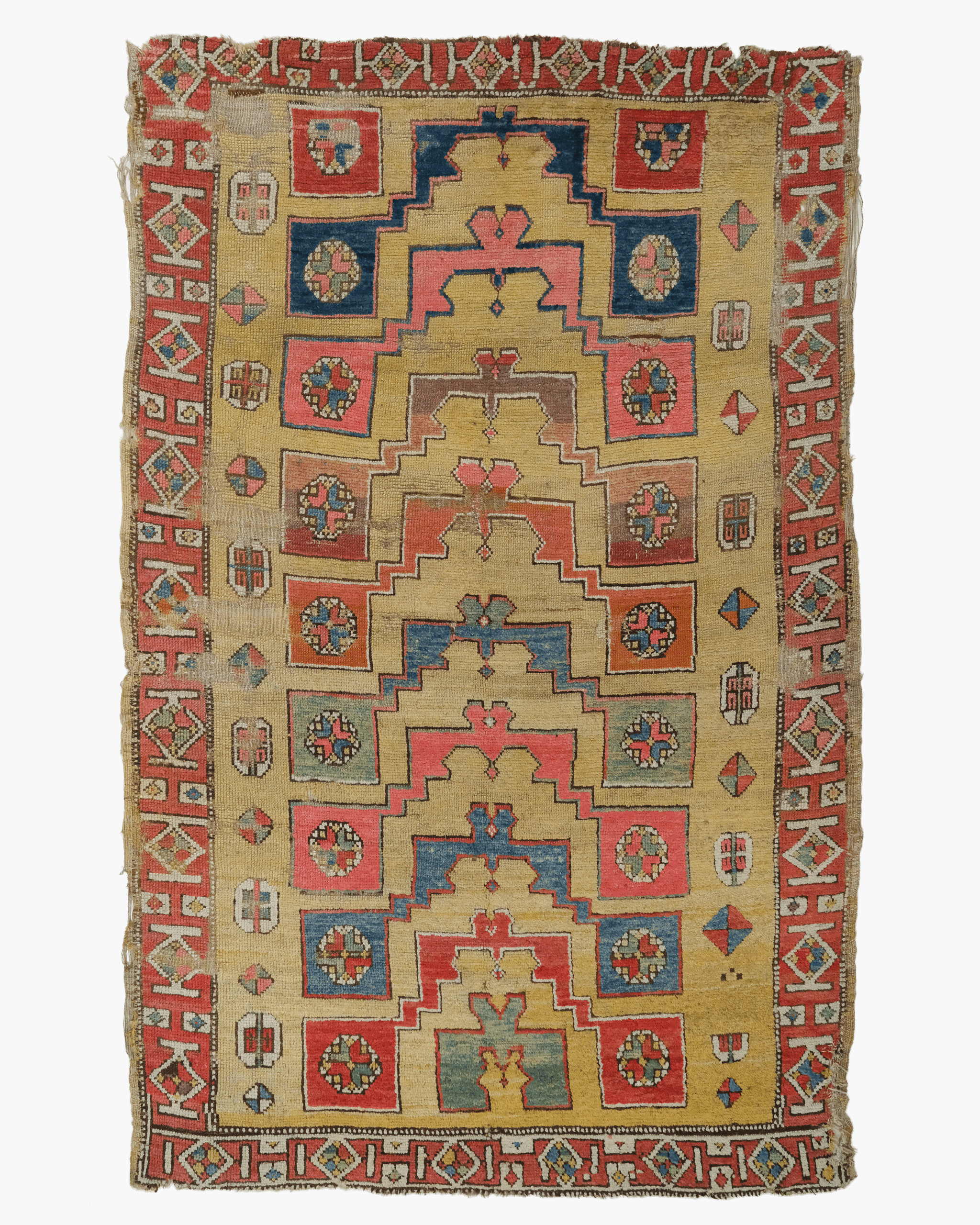


Early 18th Century Cappadocia Rug
Period: Early 18th Century
Origin: Cappadocia, Anatolia
Dimensions: 140 x 226 cm
The visual evidence from the surface and knot structure of this 18th-century Cappadocia rug provides definitive proof of its archaic handmade nature and three-century-old authenticity. The analysis confirms that the central stepped pyramidal motif and the saturated mustard yellow and madder red tones possess a color depth only achievable through natural dyes. This is the most critical and rare distinguishing feature of the Central Anatolian weaving tradition.
The data indicates that the wool is entirely hand-spun and the knot density exhibits a natural irregularity consistent with its period. These inherent “abrash” (color variations) and characteristic deviations in the knots definitively distinguish this piece from modern reproductions, which show a much more uniform and mechanical thread arrangement. Furthermore, the patina and natural signs of aging on the wool align perfectly with a piece dating to the early to mid-18th century.
Based on this structural evidence, the work in question is a highly valuable example of Early Period Anatolian weaving art and the architectural symbolism of the Cappadocia region. Its historical significance and the fact that such archaic motifs have reached the present day in this condition make it a priceless acquisition for world-class collectors. Protecting the piece from direct sunlight and maintaining humidity balance to prevent fiber desiccation will ensure the preservation of this extraordinary cultural heritage.
Stock No : 5090
Related products
Antique Cappadocia Rug
Antique Ghordes Prayer Rug
Antique Sivas Fragment





 Mimar Mehmetağa Cad. No:10 Sultanahmet / ISTANBUL